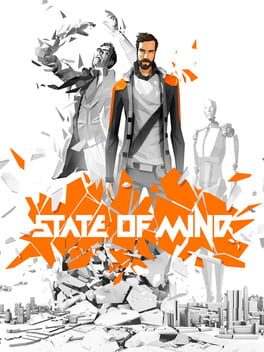

State of Mind is Daedalic’s attempt to enter a new genre, the narrative 3D adventure, presenting an unfamiliar, independent low-poly graphics style. The central question that illuminates my review is whether this ambitious genre change has succeeded and to what extent State of Mind is fun. The storyline of State of Mind is thematically very interesting and focuses on the dystopian city of the future Berlin in 2048. The world is dominated by smouldering resource wars and a sophisticated technology that makes everyday life easier with androids. A development that is deeply rejected by Richard Nolan, our protagonist. The player assumes the role of Richard, an irritable and rather unsympathetic star journalist. The story begins at a low point in his life: After a mysterious accident, he suffers from massive memory gaps, and his wife and son have disappeared without a trace. The central narrative engine is the search for the truth behind these events, which leads the player deep into the abysses of the digital dictatorship and the lure of the virtual utopia "City 5". History plays skillfully with the identity and value of human consciousness. The game forms an ambitious construct that addresses central issues of transhumanism, overcapitalism and the value of human emotions and can be located thematically between Deus Ex: Mankind Divided and Detroit: Become Human, both of which coincidentally were also released in the same year. However, the story would have benefited from a longer run length, as the resolution unfortunately seems over-hasty and loses depth. Nevertheless, the characters, especially the deliberately unsympathetic protagonist Richard, are intelligent and multi-layered, which still gives the bittersweet epilogue a stronger emotional impact. On the gameplay side, State of Mind is designed as a classic telltale-like adventure (sic). The player moves through limited areas in the third-person perspective, interacting with objects and following dialogues. My main criticism lies in the irrelevance of decision-making possibilities. The dialogue options rarely lead to significant narrative consequences beyond a mere deviation of the dialogues, which reduces replayability. This is complemented by very simple sliding puzzles, which are primarily used for stretching and in one case were even affected by a bug and softlocked me. Technically, State of Mind is based on the Unreal Engine 4. The game impresses visually with a characteristic low-poly style in combination with high-reflective materials. This aesthetic approach generates a stylish, harmonious cyberpunk feel through the use of high-quality screenspace reflections and targeted glare effects and compensates for the lower detail density of textures and the sometimes crude facial animations. The performance is consistently good; The game runs smoothly and stable on almost any hardware. The acoustic backing shall be considered as good to adequate. While the soundtrack does not offer a wide range, it feels limited to about six main tracks, but these are memorable and support the atmosphere effectively. The German synchronization is mixed; Some speakers of "old school" tend to overact and a not always scene-appropriate intonation. Despite the weaknesses in the gameplay and the hasty ending, State of Mind is an entertaining, exciting and gripping narrative adventure. The playtime allows play through in one or two intensive sessions, which benefits the density of the story. Given the current very low price, State of Mind offers a high return and is a clear recommendation for fans of thematically demanding sci-fi stories. It is the visible proof of passion and ambition in a new format for the studio and a successful game.
Translated from German
Comments
0No comments yet.
Sign in to comment.